
1-inch thick steel plate is a widely used medium-thick plate product in industrial production, construction, machinery manufacturing and other fields. This article provides a one-stop guide covering its specifications, material selection, pricing, weight calculation, processing services and purchasing channels, in accordance with industry standards and practical application scenarios.

I. Materials of 1-Inch Thick Steel Plate
Carbon Steel Plate
As the most widely used and cost-effective category in the industry, it features easy machinability, moderate strength and controllable costs. Common grades include Q235B, A36 and SS400. A36 is an internationally universal grade, Q235B is the mainstream grade in China, and SS400 is suitable for general machinery applications. Such 1-inch thick carbon steel plates are mainly used in building structures (e.g., steel structure supports, embedded parts), mechanical components (e.g., machine tool bases, equipment supports), auto parts and general hardware processing, ideal for scenarios with low corrosion resistance requirements and high cost-performance priorities.
Stainless Steel Plate
Its core advantages are corrosion resistance, high temperature resistance and easy maintenance. The commonly used grade is 304 (mainstream general-purpose type), and 316L (with stronger corrosion resistance for marine and chemical environments) can be selected for high-end applications. 1-inch thick stainless steel plates are mostly used in food and beverage equipment, marine engineering, chemical containers, medical equipment and other fields. Due to high material costs, their prices are much higher than carbon steel plates.
Other Special Steel Plates
These include tool steel, high-strength low-alloy (HSLA) steel plates, and checker plates. 1-inch thick tool steel plates feature high hardness and wear resistance, suitable for mold making, tool processing and other applications; high-strength low-alloy steel plates (e.g., S355JR) have higher strength than ordinary carbon steel, used in heavy machinery, bridge construction and other high-load scenarios; checker plates with anti-slip patterns on the surface are widely used for platforms, steps, carriage floors and other anti-slip applications.
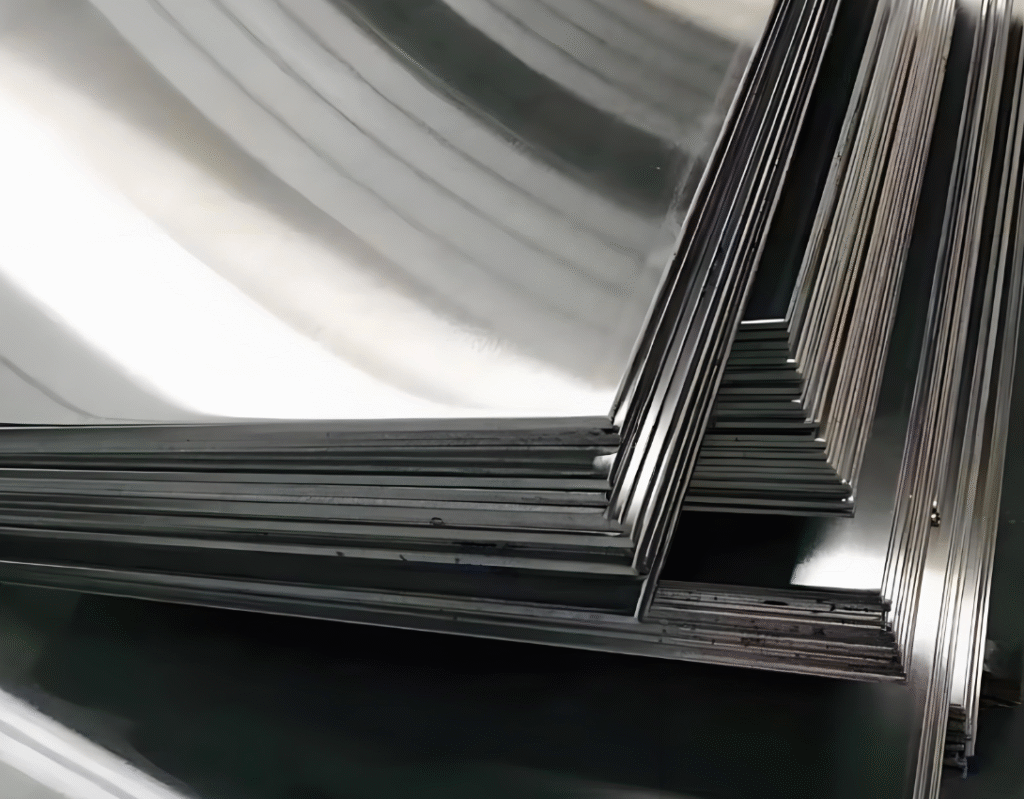
II. Specification Parameters of 1-Inch Thick Steel Plate
- Thickness and Tolerance: The standard thickness is 1 inch (precisely converted to 25.4 mm). The common industry tolerance range is ±0.07 in (approx. ±1.78 mm), and high-precision applications can reach -0.004 in (approx. -0.10 mm). Smaller tolerances mean higher machining accuracy and correspondingly higher prices. In actual procurement, an appropriate tolerance grade should be selected based on the precision requirements of the application to avoid assembly or performance issues caused by excessive tolerances.
- Mechanical Properties: Mechanical properties vary significantly by material. For 1-inch thick A36 carbon steel plate, the yield strength is 54,000 psi (approx. 372 MPa), Brinell hardness is 70 BHN, and tensile strength is 70,000–90,000 psi (approx. 483–621 MPa), meeting strength requirements for most construction and machinery applications. For 304 stainless steel plate, the yield strength is approx. 30,000 psi (approx. 207 MPa) and tensile strength approx. 75,000 psi (approx. 517 MPa), emphasizing corrosion resistance. Q235B carbon steel plate has a yield strength ≥235 MPa and tensile strength of 375–500 MPa, suitable for domestic construction and general machinery applications.
- Standard Sizes and Customization Range: Common standard length and width specifications are 6 in × 6 in, 6.5 in × 12 in, 48 in × 120 in (converted to mm: 152.4 mm × 152.4 mm, 165.1 mm × 304.8 mm, 1219.2 mm × 3048 mm). Any custom length and width are available, with a maximum custom size of 2.5 m × 12 m for large equipment and steel structures. Surface treatments include pickling, sandblasting and phosphating. Pickling removes surface scale for subsequent processing; sandblasting improves surface roughness and coating adhesion, which can be selected based on processing needs.
- Quality Certifications: Mainstream 1-inch thick steel plates are required to have relevant quality certifications, including BV, SGS and ISO9001. ISO9001 is a basic quality certification ensuring compliant production processes; BV and SGS certifications are mainly for export or high-end applications, verifying compliance with international standards.

III. Price of 1-Inch Thick Steel Plate
Prices of 1-inch thick steel plates are affected by material, specifications, order quantity, custom processing, transportation and other factors. Based on real-time quotes from platforms such as Alibaba, Grainger and Bobco Metals (reference prices as of March 2026), prices are categorized by material as follows:
- Carbon Steel Plate: 1-inch thick carbon steel plates (Q235B, A36, SS400) are priced at **US$390–699 per ton**, with a typical MOQ of 1 ton. Bulk orders (≥5 tons) enjoy discounts, reducing prices to US$370–650 per ton. As an international standard grade, A36 is slightly more expensive at US$420–699 per ton, while Q235B, the mainstream domestic grade, is more affordable at US$390–650 per ton.
- Stainless Steel Plate: 1-inch thick 304 stainless steel plates are priced at **US$122.76–613.24 per piece** (calculated for the standard size 48 in × 120 in), equivalent to approx. US$2,800–3,200 per ton, with an MOQ of 1 piece. Bulk orders (≥10 pieces) qualify for a 10%–15% discount. 316L grade is more expensive at approx. US$150–700 per piece, suitable for high-end corrosion-resistant applications.
- Other Materials: 1-inch thick carbon checker plates cost US$580–610 per ton with an MOQ of 5 tons; tool steel plates cost approx. US$800–1,200 per ton with an MOQ of 1 ton; high-strength low-alloy steel plates (S355JR) cost approx. US$550–750 per ton with an MOQ of 1 ton.
- Price Influencing Factors:
- Material: Stainless steel > Tool steel > High-strength low-alloy steel > Carbon steel
- Specifications: Custom sizes and high-precision tolerance plates cost 10%–30% more than standard specifications
- Order quantity: Smaller MOQ leads to higher unit price; bulk purchasing significantly reduces costs
- Custom processing: Cutting, bending, surface treatment and other services add extra costs, e.g., laser cutting at approx. US$50–100 per square meter
- Transportation: International shipping (e.g., from China to Europe and the US) adds US$20–50 per ton, while domestic transportation costs are lower at approx. US$5–15 per ton

IV. Weight of 1-Inch Thick Steel Plate
4.1 Weight Calculation Formulas
Weight calculation of 1-inch thick steel plates is essential for engineers, construction personnel and logistics staff. Based on Civil Tutorials and industry standard formulas, both imperial and metric calculation methods are provided with density references for accurate results:
- Imperial Formulas (unit: lb):
- Weight (lb) = Length (in) × Width (in) × Thickness (in) × 0.2836
- Weight (lb) = Area (ft²) × Thickness (in) × 40.8(Note: A 1-square-foot, 1-inch thick carbon steel plate weighs approx. 40.8 lb for quick estimation)
- Metric Formula (unit: kg):Weight (kg) = Length (m) × Width (m) × Thickness (mm) × 7.85This is the general industry formula in China, simple to calculate and sufficiently accurate for most applications. 7.85 is the reference density of carbon steel (g/cm³); adjust the density for different materials.
- Density Reference:Carbon steel: 7.85 g/cm³Stainless steel (304, 316L): 7.93 g/cm³Tool steel: 7.80 g/cm³High-strength low-alloy steel: 7.85 g/cm³Checker plate: 7.85 g/cm³ (weight of patterned parts calculated by actual area)
4.2 Calculation Examples
Imperial Example
Calculate the weight of a 48 in × 24 in × 1 in A36 carbon steel plate:
- Formula 1: Weight = 48 × 24 × 1 × 0.2836 ≈ 326.9 lb
- Formula 2: Area = (48÷12) × (24÷12) = 8 ft²Weight = 8 × 1 × 40.8 = 326.4 lbResults are nearly identical with acceptable error.
Metric Example
Calculate the weight of a 2 m × 1 m × 25.4 mm (1 in) 304 stainless steel plate:
- Density: 7.93 g/cm³
- Weight = 2 × 1 × 25.4 × 7.93 ≈ 403.5 kg
- Conversion to ton: 403.5 kg ÷ 1000 = 0.4035 tonFor logistics and transportation weight estimation.
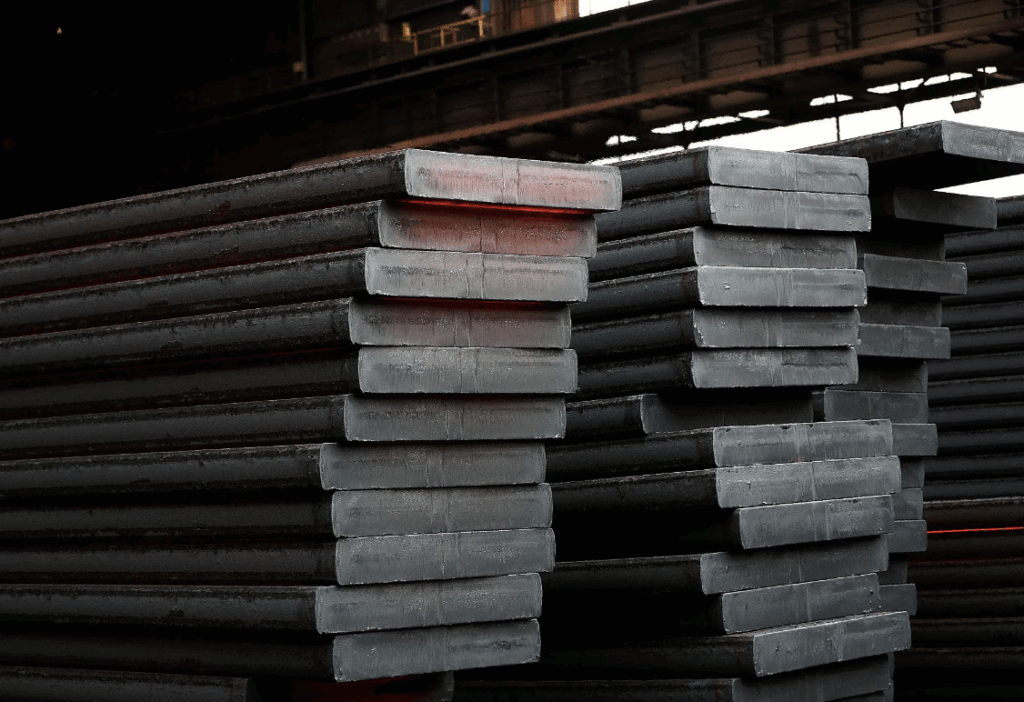
V. Application Scenarios of 1-Inch Thick Steel Plate
- Construction & Infrastructure: Bridge bearing plates, heavy equipment foundation bases, industrial workshop floor reinforcement layers
- Heavy Machinery Manufacturing: Crane chassis, large press bases, mining machinery structural parts
- Shipbuilding & Marine Engineering: Hull plates, decks, bulkhead structures, wharf fender brackets
- Security & Special Structures: Vault doors, ballistic target plates, explosion-proof walls, military bunkers
- Molds & Tooling: Large mold bases, welding fixture platforms, test benches
VI. Processing of 1-Inch Thick Steel Plate
Cutting
The most common processing service, cutting to any size or shape. Main methods:
- Laser cutting: High precision (±0.2 mm), surface roughness Ra ≤ 25 μm, no slag or deformation, ready for direct assembly without secondary milling, suitable for high-precision applications
- Plasma cutting: Fast speed for mass production, slightly lower precision1-inch thick steel plates can be laser cut into special holes, curved contours and spliced shapes, with a maximum processing size of 2.5 m × 12 m, daily capacity of 30 ㎡ for bulk orders, and urgent parts completed within 24 hours.
Welding & Bending
- Welding: Joins multiple plates into required dimensions using arc welding and gas shielded welding, followed by UT/MT flaw detection to ensure quality
- Bending: Forms angles of 90°–180° via 1000T CNC press brakes, with segmented bending and fixture fixing to prevent springback. Minimum bending radius is 0.8 times the plate thickness (for 1–50 mm thickness), suitable for U-grooves, L-brackets, box structures and more.
Surface Treatment
Improves corrosion resistance, wear resistance and appearance. Common methods:
- Pickling: Removes surface scale
- Sandblasting: Enhances coating adhesion
- Phosphating: Boosts rust resistance
- Electroplating (galvanizing, chrome plating): Improves appearance and corrosion resistance
- Spraying (painting, powder coating): Custom colors for outdoor anti-corrosion and extended service life
VII. Frequently Asked Questions
Q1: How much does a 1-inch thick steel plate cost?
A: Prices vary by material, specifications and order quantity. Carbon steel (Q235B, A36): US$390–699/ton; 304 stainless steel: US$122.76–613.24/piece; checker plate: US$580–610/ton. Bulk discounts are available; contact suppliers for real-time quotes.
Q2: What is the weight of a 1 square foot, 1-inch thick steel plate?
A: Carbon steel: approx. 40.8 lb (18.5 kg); 304 stainless steel: approx. 41.3 lb (18.7 kg). Exact weight can be calculated using the formulas provided.
Q3: What is the best material for a 1-inch thick steel plate?
A: No absolute “best” material — select based on application: carbon steel for construction and general machinery (cost-effective); stainless steel for food, marine and chemical industries (corrosion-resistant); tool steel for molds and tools (high hardness); high-strength low-alloy steel for heavy machinery and bridges (high strength).
Q4: Can 1-inch thick steel plates be customized?
A: Yes. Custom sizes, materials and processing (cutting, welding, bending, surface treatment) are available. Lead time: 14–30 days, small-batch customization in 7–10 days, urgent orders in 24 hours.
Q5: What quality certifications are required for 1-inch thick steel plates?
A: Basic certification: ISO9001. Export or high-end applications require BV or SGS certifications to meet international standards. Suppliers can provide certification reports upon request.
Q6: What cutting accuracy can be achieved for 1-inch thick steel plates?
A: Laser cutting: ±0.2 mm (for 1–50 mm thickness), slag-free and deformation-free, ready for direct assembly. Plasma cutting: approx. ±0.5 mm, suitable for high-volume, low-precision applications.
VIII. Conclusion
When selecting a 1-inch thick steel plate, buyers should first clarify their application scenario, order quantity and budget, and choose the appropriate material accordingly.
If you need 1-inch thick steel plates, please contact Tonghui!
References
- Chinese Steel Structure Industry Standard (GB/T 700-2006)
- International Steel Standard (ASTM A36)


 English
  Spanish
  Afrikaans