
En los proyectos de acero estructural en el extranjero, la construcción de edificios, el aprovisionamiento de acero y la estimación de costes, el peso de la chapa de acero por pie cuadrado constituye un parámetro técnico fundamental. Se utiliza ampliamente para el cálculo de cargas en los forjados, la elaboración de presupuestos de ingeniería, la medición de materiales y el diseño de contrapesos para equipos. A diferencia del sistema métrico (metros cuadrados, kilogramos) que se utiliza habitualmente a nivel nacional, los sectores de la ingeniería de Europa y América adoptan de forma unánime las unidades imperiales (pies cuadrados, libras) para medir el peso de las chapas de acero. Esta medida constituye un dato de referencia esencial para la ejecución de proyectos transfronterizos y la elaboración de presupuestos en el comercio del acero.
La densidad estándar del sector del acero dulce convencional con bajo contenido en carbono Chapa de Acero es de 490 lb/ft³, lo que sirve como referencia unificada para el cálculo del peso en el sistema de medidas imperial. Proporciona resultados teóricos precisos sobre el peso para la mayoría de las chapas de acero estructural comunes. Las chapas de acero fabricadas con diferentes materiales y mediante distintos procesos de fabricación (chapas de acero inoxidable, chapas estriadas) presentan densidades ligeramente diferentes, lo que da lugar a pesos distintos por unidad de superficie. A continuación se detallarán estos aspectos con fórmulas estándar y datos de referencia prácticos.

1. Fórmula estándar para calcular el peso de una chapa de acero por pie cuadrado
El cálculo del peso de una chapa de acero se basa en el siguiente principio físico fundamental: Volumen × Densidad. Si se combinan con las reglas de conversión de unidades imperiales, se puede obtener una fórmula práctica y simplificada, adecuada para la estimación técnica in situ, lo que elimina las engorrosas conversiones secundarias y permite realizar cálculos rápidos sobre el terreno.
1.1 Fórmula universal de cálculo imperial
Peso de la chapa de acero por pie cuadrado (libras/pie cuadrado) = Espesor de la chapa (pulgadas) × 40,83
Esta fórmula simplificada se deriva de la densidad estándar del acero al carbono, que es de 490 lb/ft³. Evita las complejas conversiones entre unidades cúbicas y cuadradas y es la fórmula abreviada más utilizada entre los profesionales de la ingeniería en el extranjero. Los resultados de los cálculos presentan un margen de error inferior a 0,51 TP3T en comparación con los pesos teóricos oficiales, lo que cumple plenamente los requisitos de precisión para las estimaciones de ingeniería y los presupuestos de adquisición.
1.2 Ejemplos de cálculos paso a paso
Tomamos los espesores de chapa de acero al carbono más habituales —1/4 de pulgada (0,25 pulgadas), 1/2 pulgada (0,5 pulgadas) y 1 pulgada— para ilustrar el proceso de cálculo:
- Chapa de 1/4 de pulgada: 0,25 × 40,83 = 10,21 libras por pie cuadrado
- Chapa de 1/2 pulgada: 0,5 × 40,83 = 20,42 libras por pie cuadrado
- Placa de 1 pulgada: 1 × 40,83 = 40,83 libras por pie cuadrado
1.3 Distinción entre placa de acero y chapa de acero
Existen definiciones claras para Placa De Acero y Chapa de acero en la industria internacional. Los materiales con un espesor ≥ 3/16 de pulgada se definen como chapas de acero, utilizadas principalmente para estructuras portantes, bases de equipos y construcción de suelos. Los materiales de espesor inferior a 3/16 de pulgada se clasifican como chapas de acero, que suelen emplearse para cerramientos, elementos decorativos y componentes ligeros. Ambos comparten fórmulas idénticas para el cálculo de la densidad y el peso, y solo difieren en sus ámbitos de aplicación.
2. Tabla de referencia de pesos estándar para chapas de acero de diversos materiales
Basándonos en las especificaciones que se suelen adoptar en proyectos de ingeniería en el extranjero, hemos recopilado los pesos unitarios estándar por unidad de superficie de los tres tipos principales de chapas de acero —acero al carbono, acero inoxidable y chapa estriada—, que pueden utilizarse directamente para consultas y cálculos.
2.1 Tabla de pesos de chapas de acero al carbono de baja resistencia (material estructural principal)
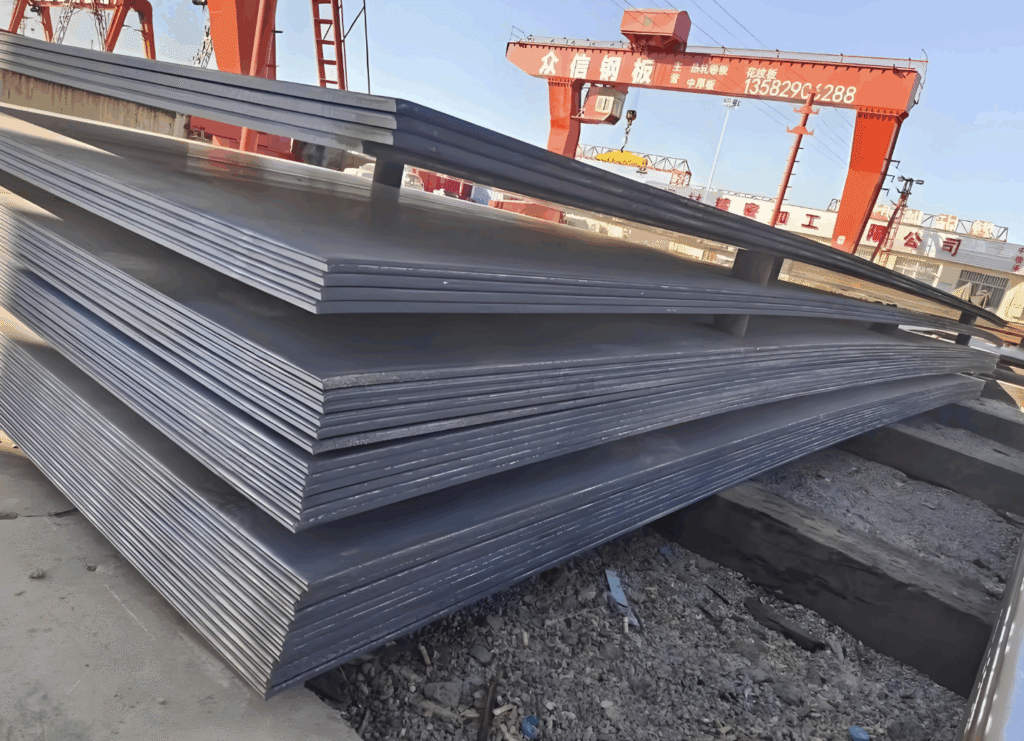
Chapa de acero al carbono Es el material predominante en la construcción y la ingeniería estructural del acero. Las especificaciones cumplen con las normas ASTM adoptadas en Europa y Norteamérica. A continuación se indican los datos de peso pertinentes.
| Espesor de la chapa (pulgadas) | Peso teórico (libras/pie cuadrado) | Escenarios de aplicación básicos |
|---|---|---|
| 1/8″ | 5.10 | Cajas de luz, pequeños accesorios, elementos decorativos |
| 3/16″ | 7.66 | Estructura de acero ligero, placas protectoras de los equipos |
| 1/4″ | 10.21 | Losas de forjado normales, placas de plataforma, estructuras portantes convencionales |
| 3/8″ | 15.31 | Bases para maquinaria de uso medio, plataformas de soporte de carga |
| 1/2″ | 20.42 | Placas estructurales principales; placas de vigas primarias y secundarias del edificio |
| 3/4″ | 30.62 | Placas de base para maquinaria pesada, estructuras portantes de alta resistencia |
| 1″ | 40.83 | Estructuras pesadas de acero, contrapesos mecánicos, elementos de cimentación que soportan cargas |
2.2 Tabla de pesos de chapas de acero inoxidable (aplicaciones resistentes a la corrosión y a la intemperie)
Los grados más comunes, entre los que se incluyen el 304 y Acero inoxidable 316 Tienen una densidad ligeramente superior a la del acero al carbono común, con una densidad media de 498 lb/ft³. Se utilizan en instalaciones químicas, instalaciones al aire libre y proyectos expuestos a entornos húmedos y corrosivos.
| Espesor de la chapa (pulgadas) | Peso del acero inoxidable 304 (libras/pie cuadrado) | Escenarios de aplicación |
| 1/4″ | 10.38 | Plataformas para exteriores y placas para equipos químicos |
| 1/2″ | 20.76 | Estructuras portantes anticorrosivas y componentes de equipos de tratamiento de agua |
| 1″ | 41.52 | Bases para equipos de alta resistencia y anticorrosión |
2.3 Tabla de pesos de chapas antideslizantes (para suelos antideslizantes de uso especial)
Las chapas antideslizantes presentan un relieve antideslizante en la superficie. Su peso total es entre 5% y 8% superior al de las chapas de acero al carbono normales del mismo espesor. Se utilizan principalmente para la construcción antideslizante de suelos de fábricas, peldaños de escaleras y plataformas de trabajo.
| Espesor de la placa base (pulgadas) | Peso total de la chapa de acero estriada (libras/pie cuadrado) | Descripción de la aplicación |
| 1/4″ | 10.95 | Suelos y peldaños antideslizantes para fábricas en general |
| 1/2″ | 21.85 | Plataformas para talleres de uso intensivo y suelos para equipos de trabajo |
Preguntas Frecuentes
P1: ¿Cuál es el peso estándar de una chapa de acero lisa por pie cuadrado?
El peso de una chapa de acero no es fijo y depende principalmente de su espesor. Tomando como referencia los espesores más habituales: una chapa de 1/4 de pulgada pesa aproximadamente 10,21 libras/pie cuadrado, una de 1/2 pulgada pesa unos 20,42 libras/pie cuadrado y una de 1 pulgada alcanza las 40,83 libras/pie cuadrado. Se puede calcular rápidamente el peso de cualquier espesor utilizando la fórmula: Espesor (pulgadas) × 40,83.
Pregunta 2: ¿Qué material pesa más, la chapa de acero inoxidable o la de acero al carbono?
Con el mismo espesor y superficie, la chapa de acero inoxidable es ligeramente más pesada que la de acero al carbono. La densidad del acero inoxidable de grado 304 es de aproximadamente 498 lb/ft³, frente a las 490 lb/ft³ del acero al carbono, lo que supone una diferencia de peso de entre 1,5% y 2%. Para una estimación de costes de alta precisión es necesario realizar un seguimiento estadístico por separado, mientras que para la elaboración de presupuestos de ingeniería generales bastan unos valores aproximados universales.
Pregunta 3: ¿En qué situaciones de ingeniería se pueden aplicar estos datos sobre el peso de las chapas de acero?
Los parámetros de peso estándar descritos en este artículo se aplican a edificios civiles en el extranjero, instalaciones industriales, obras de acero estructural, fabricación de equipos, plataformas marinas y el comercio de importación y exportación de acero. Sirven de apoyo a operaciones de ciclo completo, incluyendo la verificación de cargas, la elaboración de presupuestos, la adquisición de materiales, los trabajos de elevación y la liquidación de cantidades.
Conclusión
El cálculo preciso del peso de las chapas de acero por pie cuadrado constituye la base de la ingeniería estructural del acero y del comercio de acero a nivel internacional. La fórmula simplificada ampliamente utilizada —espesor (pulgadas) × 40,83— permite calcular rápidamente el peso de las chapas de acero al carbono. En combinación con las tablas de referencia con especificaciones completas, los datos de peso de las chapas estándar de 4 pies × 8 pies y los parámetros de conversión de unidades recopilados en este artículo, este recurso cubre las necesidades prácticas en los ámbitos de la construcción, el diseño, el aprovisionamiento y el control de costes.
Además, los datos de peso diferenciados para el acero inoxidable y las chapas estriadas responden a requisitos técnicos específicos, como la resistencia a la corrosión y las propiedades antideslizantes, lo que proporciona una base de datos fiable para la medición precisa, la gestión de costes y la construcción segura en proyectos transfronterizos.
Referencias
- Norma ASTM A36: Especificación estándar del sistema de parámetros dimensionales y de peso de las chapas de acero al carbono para aplicaciones estructurales
- GB 4229-84: Norma nacional para el cálculo del peso teórico de las chapas de acero inoxidable
- Manual general sobre el sistema imperial de unidades de medida y el cálculo de cargas en la ingeniería estructural del acero en el extranjero




 English
  Spanish
  Afrikaans