
In engineering scenarios such as building construction, machinery manufacturing, and equipment installation, the 1/4 inch (6.35mm) steel plate is one of the most widely used basic steel products. The accuracy of its weight directly affects engineering budget calculation, material procurement planning, transportation scheme formulation, and construction safety control. This article integrates industry standard data, practical calculation methods, and clear comparison tables to help you solve all questions related to the weight of 1/4 inch steel plate in one stop.
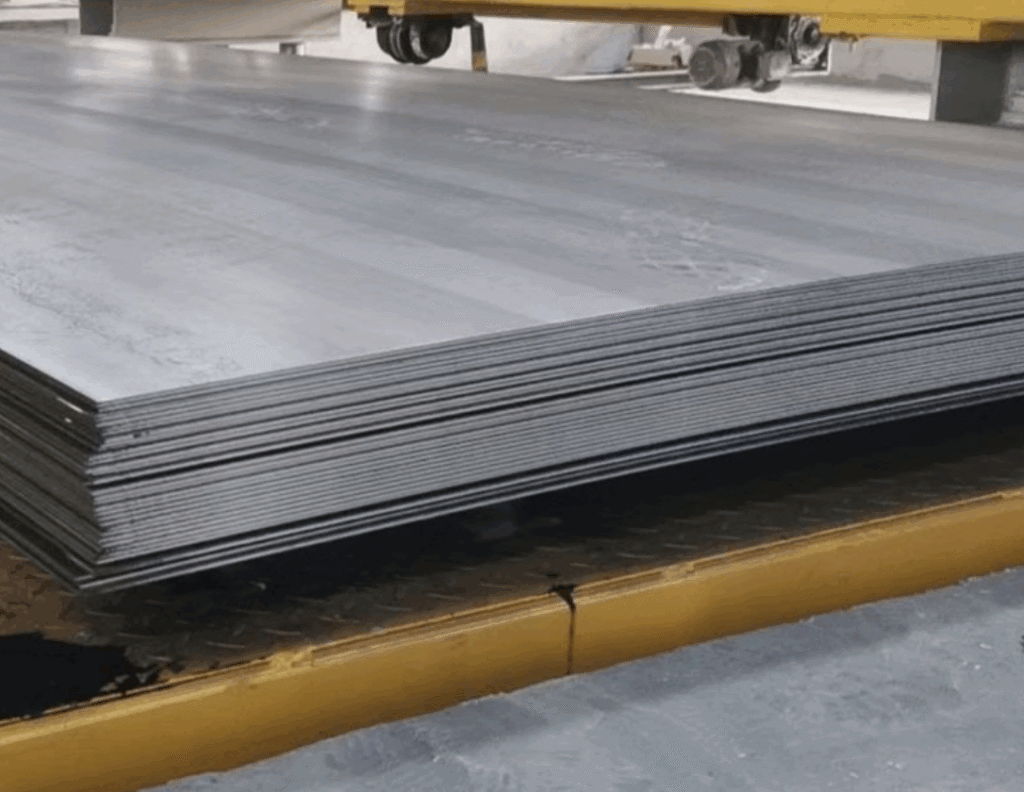
1. Weight of 1/4 Inch Steel Plate
1.1 Weight per Square Foot
As the most commonly referenced standard for the weight of 1/4 inch steel plate in engineering, based on industry-general carbon steel (Q235, A36, etc.), its weight per square foot is approximately 10.21 pounds (about 4.63 kilograms). This value is calculated based on the standard density of carbon steel at 7850kg/m³ (489.6lb/ft³), complying with the Chinese standard GB/T 700-2006 for carbon steel and the ASTM A36 steel specification, serving as the core reference for engineering calculations.
It should be noted that the weight of 1/4 inch steel plate varies slightly for different materials, mainly due to differences in material density: the weight of 1/4 inch 304 stainless steel plate per square foot is about 3.149 pounds (approx. 1.43kg). Galvanized steel, tool steel (A2), and high-strength low-alloy (HSLA) steel plates all have a weight of 3.149 pounds per square foot, with negligible differences. In actual procurement, values can be taken according to the corresponding material standards.
1.2 Weight Comparison Table for Common Sizes of 1/4 Inch Steel Plate
In engineering procurement, the most frequently used sizes of 1/4 inch steel plate are 4×8ft, 4×10ft, etc. The following is an accurate weight comparison table (dual units in pounds and kilograms, suitable for domestic and international procurement scenarios). The values are theoretical approximations in line with industry calculation standards; the actual weight may fluctuate slightly due to manufacturing processes (hot-rolled/cold-rolled) and minor deviations in material composition (fluctuation range: ±2%).
| Steel Plate Specification (Thickness × Length × Width) | Weight (LBS) | Weight (KG) | Applicable Material |
| 1/4 Inch × 4 Feet × 8 Feet | 163.2 | 74.0 | Ordinary Carbon Steel (Q235, Q355) |
| 1/4 Inch × 4 Feet × 10 Feet | 412 | 187 | Ordinary Carbon Steel (Q235, Q355) |
| 1/4 Inch × 3 Feet × 8 Feet | 247.92 | 112.50 | Ordinary Carbon Steel (Q235, Q355) |
| 1/4 Inch × 8 Feet × 8 Feet | 661.12 | 299.94 | A36 Carbon Steel (Engineering Preferred Material) |
| 1/4 Inch × 4 Feet × 12 Feet | 495.84 | 224.96 | A36 Carbon Steel (Engineering Preferred Material) |
1.3 Weight Comparison Table for 1/4 Inch Steel Plate of Different Materials
In engineering selection, material differences directly affect the weight of steel plates and their application scenarios. The following lists the weight and density parameters of 1/4 inch steel plate for commonly used industrial materials, precisely matching procurement and selection requirements, with data conforming to industry standards for corresponding materials.
| Steel Plate Material | Weight per Square Foot (LBS) | Density Parameters (Common Units) | Typical Application Scenarios |
| Ordinary Carbon Steel (Q235) | 10.21 | 7850kg/m³ (489.6 lbs/cu ft) | Building structures, ordinary equipment enclosures |
| A36 Carbon Steel | 10.21 | 7850kg/m³ (489.6 lbs/cu ft) | Bridges, machinery manufacturing, engineering load-bearing components |
| 304 Stainless Steel | 3.149 | 8000kg/m³ (0.289 lbs/cu in) | Food equipment, corrosion-resistant scenarios |
| Galvanized Steel | 3.149 | 7850kg/m³ (0.283 lbs/cu in) | Outdoor facilities, rust-proof demand scenarios |
| A2 Tool Steel | 3.149 | 7850kg/m³ (0.283 lbs/cu in) | Mold manufacturing, wear-resistant components |
| HSLA High-Strength Low-Alloy Steel Plate | 3.149 | 7850kg/m³ (0.283 lbs/cu in) | Heavy equipment, engineering structural components |

2. Calculation Method for 1/4 Inch Steel Plate Weight
2.1 Core Calculation Formula
Steel plate weight calculation in engineering follows a universal formula, accurately applicable to 1/4 inch steel plate, supporting both imperial and metric units to avoid calculation errors caused by unit confusion. The formulas are as follows:
Core Formula:
Weight (kg) = Volume (m³) × Density (kg/m³);
Weight (lb) = Volume (ft³) × Density (lb/ft³)
Supplementary Note:
Volume = Length × Width × Thickness (units must be consistent, e.g., imperial units unified as feet/inches, metric units unified as meters/millimeters). The density of commonly used steel plates can be directly applied: carbon steel 7850kg/m³ (489.6lb/ft³), stainless steel 8000kg/m³, galvanized steel and tool steel 7850kg/m³, with no additional conversion required.
In addition, an industry simplified formula (for quick estimation of 1/4 inch steel plate) can be used:
Steel plate weight (kg) = Length (m) × Width (m) × 0.00635 (m, converted value of 1/4 inch) × 7850 (density)
Derived from carbon steel density, this formula features high calculation efficiency with an error ≤1%, suitable for on-site quick calculation.
2.2 Step-by-Step Calculation Example (Taking 4×8ft 1/4 Inch Carbon Steel Plate as an Example)
Combined with practical engineering scenarios, the step-by-step calculation is demonstrated for easy mastery by beginners, ensuring accurate and reusable results:
- Determine core parameters: plate thickness 1/4 inch (0.25in), size 4ft × 8ft, material is ordinary carbon steel, density taken as 489.6lb/ft³ (or 7850kg/m³);
- Unify units: convert thickness from inches to feet (commonly used in imperial engineering calculations), 0.25in ÷ 12in/ft ≈ 0.0208ft;
- Calculate volume: Volume = Length × Width × Thickness = 4ft × 8ft × 0.0208ft ≈ 0.6656ft³;
- Calculate weight (imperial): Weight = Volume × Density = 0.6656ft³ × 489.6lb/ft³ ≈ 163.2lb (consistent with the value in the comparison table, verifying accuracy);
- Unit conversion (metric): 1lb = 0.4536kg, 163.2lb × 0.4536 ≈ 74.0kg (suitable for metric procurement calculations).

3. Frequently Asked Questions
Q: What is the weight of 1/4 inch steel plate per square foot?
A: The weight of ordinary carbon steel 1/4 inch steel plate per square foot is approximately 10.21 pounds (4.63kg), while 304 stainless steel, galvanized steel and other materials are about 3.149 pounds (1.43kg). The difference stems from varying material densities, and corresponding material values can be used for engineering calculations.
Q: What is the weight of a 4×8ft 1/4 inch steel plate?
A: For ordinary carbon steel, it is approximately 163.2 pounds (74.0kg), and the weight is the same for A36 carbon steel. This is a theoretical value, with an actual weight fluctuation range of ±2%, which can be used for procurement quantity calculation.
Q: Does the weight of 1/4 inch steel plate vary with material?
A: Yes. Slight differences in density among different steel materials result in varying weights. For example, stainless steel has a higher density (8000kg/m³) than carbon steel (7850kg/m³), but the weight difference for 1/4 inch thickness is small. Simplification can be made in engineering if high-precision calculation is not required.
Q: What is the corresponding gauge number for 1/4 inch steel plate?
A: A 1/4 inch steel plate is generally referred to as 1/4 inch specification. In the industry, “gauge number” is more commonly used for thin steel plates with thickness less than 1/4 inch. Thick steel plates of 1/4 inch and above are mostly labeled directly with thickness values to avoid confusion.
Q: How to convert the weight of 1/4 inch steel plate from pounds to kilograms?
A: Industry general conversion standard: 1 pound (lb) = 0.4536 kilograms (kg). Simply multiply the pound value by 0.4536 to obtain the kilogram value, e.g., 163.2lb × 0.4536 ≈ 74.0kg, suitable for metric scenario calculations.
Q: Why does the actual weight of 1/4 inch steel plate differ from the calculated value?
A: It mainly stems from three factors: first, minor deviations between the actual steel composition and the standard composition; second, manufacturing processes (hot-rolled steel plates are slightly heavier than cold-rolled ones); third, surface treatment (e.g., galvanized steel is slightly heavier than ordinary carbon steel due to the galvanized layer thickness). The difference is usually within ±2%, complying with industry standards.
Q: Is there any difference between the weight of 1/4 inch A36 steel plate and ordinary carbon steel?
A: No. A36 carbon steel is a type of ordinary carbon steel with the same density (7850kg/m³) as ordinary carbon steel. Therefore, the weight of 1/4 inch A36 steel plate is identical to that of ordinary carbon steel, and the same calculation standard can be applied in engineering.
4. Conclusion
As a basic steel product in engineering and manufacturing, the weight accuracy of 1/4 inch steel plate is directly related to engineering budget, procurement planning, and construction safety, which deserves full attention.
References
- GB/T 700-2006 Carbon Structural Steels: Specifies the density standard (7850kg/m³) for ordinary carbon steel (Q235, Q355), serving as the core basis for calculating the weight of carbon steel plates.
- ASTM A36/A36M-20 Standard Specification for Carbon Structural Steel: Defines material parameters, density, and weight calculation specifications for A36 carbon steel, suitable for international procurement scenarios.
- Building Calculation – Theoretical Weight Table of Steel Plates (Open Source Geospatial Foundation China Branch): Provides theoretical weight calculation standards and basic parameters for steel plates, verifies the accuracy of values in the weight comparison table, and conforms to applications in construction engineering scenarios.




 English
  Spanish
  Afrikaans