
18 gauge (abbreviated as 18g) steel is one of the most commonly used specifications in construction, automotive, home appliance, manufacturing and other industries. Its thickness accuracy directly affects machining precision, structural strength and service performance of finished products. This article comprehensively elaborates on the thickness details, unit conversion, specification comparison, core properties and application scenarios of 18 gauge steel, providing actionable reference data for industrial use.

1. Exact Thickness of 18 Gauge Steel
1.1 Exact Thickness by Material
The thickness of 18 gauge steel is not fixed and varies slightly by material, determined by production processes, physical properties and industrial standards of different metals. Below are industry-standard thickness values complying with international and domestic norms for direct professional reference:
- Standard Carbon Steel: 0.0478 inches (1.21 mm). As the basic standard thickness of 18g steel, it is the most widely adopted option in industrial processing and construction, suitable for most conventional non-specialized scenarios and conforming to general steel measurement standards.
- Galvanized Steel: 0.0516 inches (1.31 mm). The thickness includes the galvanized coating, which not only increases overall thickness but also delivers superior corrosion resistance, ideal for outdoor and humid corrosive environments.
- Stainless Steel: 0.0500 inches (1.27 mm). Slightly thicker than standard carbon steel due to differences in material density and manufacturing processes. It features corrosion and high-temperature resistance, applicable to food processing, medical, sanitary and other special sectors, complying with universal stainless steel gauge measurement standards.
Note: The above values are standard industry figures. A normal manufacturing tolerance of ±0.001 inch (±0.025 mm) is acceptable for actual production, which can be taken as the precision control range for procurement and machining.
1.2 Unit Conversion
Originated from North America, the gauge measurement system is still widely used globally with dual inch and millimeter markings. The following precise conversions align with industrial usage habits for multi-scenario application:
- Inch to Millimeter Conversion: 1 inch = 25.4 mm. Based on this formula: standard carbon steel = 0.0478 × 25.4 ≈ 1.21 mm; galvanized steel = 0.0516 × 25.4 ≈ 1.31 mm; stainless steel = 0.0500 × 25.4 = 1.27 mm. The conversion formula is also applicable to thickness calculation of other steel gauge sizes.
- Fractional Inch Reference: 18g standard carbon steel is approximately 3/64 inch (1/32 inch = 0.03125 inch, 3/64 inch = 0.046875 inch), nearly consistent with the standard thickness of 0.0478 inch. It serves as a quick estimation benchmark, roughly equivalent to the thickness of two stacked standard paper clips when precision measuring tools are unavailable.

2. Thickness Comparison of 18 Gauge Steel
For material selection, it is necessary to compare 18g steel with other common gauges to clarify differences in thickness, strength and practical applications. All comparisons below adopt standard industrial data for direct specification reference.
2.1 Comparison with Thicker Gauges (14g, 16g)
14g and 16g steel are thicker than 18g, with distinct differences in thickness, mechanical strength and application scope:
- Thickness Comparison: 14g standard carbon steel: 0.0747 inch (1.90 mm); 16g standard carbon steel: 0.0598 inch (1.52 mm); 18g standard carbon steel: 0.0478 inch (1.21 mm). In the gauge system, the lower the gauge number, the thicker the steel, with a thickness reduction of about 0.2–0.3 mm between each grade.
- Strength Comparison: Thickness is positively correlated with structural strength. 14g offers the highest load-bearing capacity, followed by 16g, while 18g has moderate strength. 14g steel withstands heavy pressure and loads for load-bearing structures; 18g features moderate strength and can be processed without heavy machinery.
- Application Differences: 14g is widely used in structural load-bearing components, heavy machinery enclosures and large pipelines requiring high strength. 16g applies to medium-sized equipment housings, steel structure supports and automotive chassis parts. 18g is preferred for light-duty equipment casings, HVAC ductwork and decorative panels that demand light weight and easy fabrication over extreme load capacity.
2.2 Comparison with Thinner Gauges (20g, 22g)
20g and 22g are thinner than 18g, differing significantly in flexibility, fabrication difficulty and end uses:
- Thickness Comparison: 20g standard carbon steel: 0.0359 inch (0.91 mm); 22g standard carbon steel: 0.0299 inch (0.76 mm); 18g standard carbon steel: 0.0478 inch (1.21 mm). Thickness decreases by about 0.3–0.4 mm per higher gauge grade, following the gauge rule of higher number = thinner material.
- Flexibility Comparison: Thinner steel offers better flexibility. 22g delivers optimal ductility for easy bending and stamping, followed by 20g. 18g balances rigidity and machinability with excellent deformation resistance.
- Application Differences: 22g is used for decorative components, small hardware fittings and internal home appliance parts for non-load-bearing flexible fabrication. 20g is common in home appliance enclosures, small pipelines and DIY metal crafts. 18g covers scenarios requiring balanced strength and workability, such as automotive body panels, kitchen equipment and storage racks, boasting the broadest application coverage.

3. Core Properties of 18 Gauge Steel
- Optimal Structural Integrity: Moderate thickness balances rigidity and light weight, meeting strength requirements for most non-load-bearing components without excessive weight or material cost, fully complying with general hardware industry standards.
- Superior Machinability: No heavy industrial equipment is required; it supports cutting, bending, welding, stamping and other conventional fabrication processes, suitable for mass factory production and DIY metalworking. Its processing performance is consistent with standard structural steel, formable via cold bending, hot bending and arc welding.
- Cost-Effectiveness: Compared with thicker 14g/16g steel, 18g reduces raw material consumption and production costs; compared with thinner 20g/22g steel, it provides better durability and longer service life, making it an optimal choice balancing performance and budget.
- Optimized Weight: Standard 18g carbon steel weighs approximately 1.95 lbs per square foot (0.88 kg/ft²). Its lightweight design facilitates handling, transportation and on-site installation, cutting construction and logistics costs especially for HVAC ductwork and decorative panel projects.
4. Common Application Scenarios of 18 Gauge Steel
- Construction Industry: HVAC ductwork, metal posts, stair railings, roof cladding and steel structure supports. Galvanized steel is predominantly used for roofing and ductwork to enhance corrosion resistance, complementing I-beams and H-beams for non-load-bearing structural fabrication.
- Automotive Industry: Body panels, inner door panels, hood liners and exhaust system components. Standard carbon steel or stainless steel is commonly selected to balance light weight and durability, matching the lightweight and machining requirements of automotive manufacturing.
- Home Appliance Industry: Enclosures for refrigerators, washing machines and air conditioners, kitchen sinks, countertops and electrical cabinets. Stainless steel is used for kitchen equipment while galvanized steel serves outdoor appliance housings, meeting industry demands for appearance, durability and hygiene.
- Fabrication & DIY Sector: General custom metal parts, decorative panels, storage racks, metal enclosures and handcrafted products. Material selection is flexible based on project needs, supporting both industrial mass production and personal DIY fabrication.

5. Machining Precautions for 18 Gauge Steel
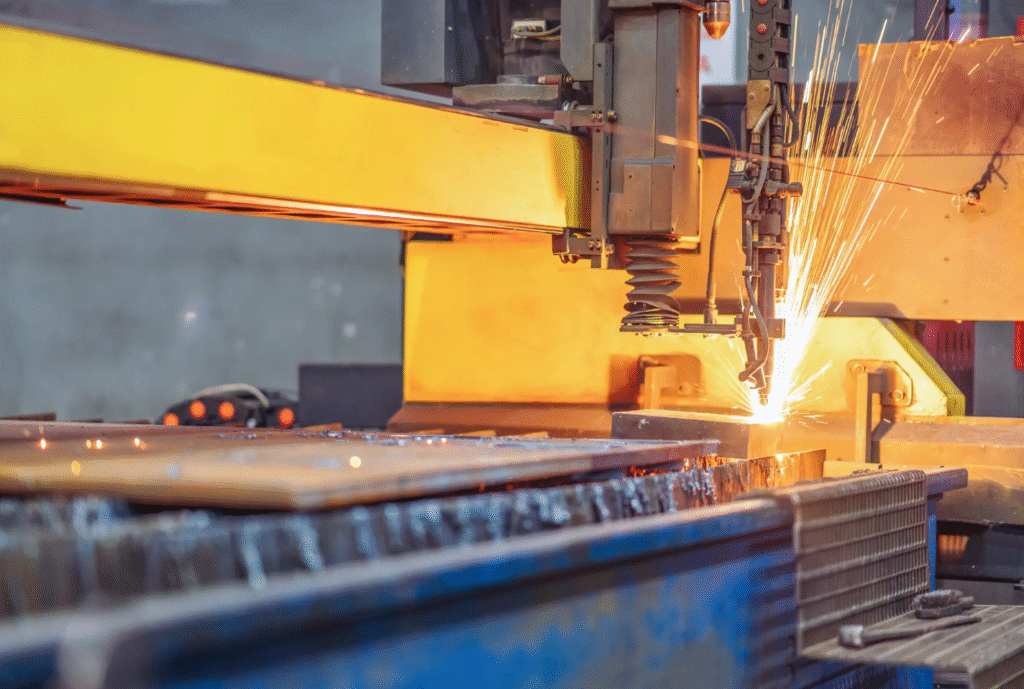
- Cutting: Use angle grinders or plasma cutters for standard cutting operations. Wear protective gear to avoid spark injuries and control cutting tolerance within ±0.002 inch (±0.05 mm) to ensure dimensional accuracy for subsequent processing.
- Bending: 18g steel features moderate flexibility and can be cold-bent via press brakes or manual forming without heating (except for special alloys). The recommended minimum bend radius is 2 times the steel thickness to prevent cracking at bend lines.
- Welding: Standard carbon steel supports arc welding and MIG/TIG welding; remove surface rust and oil contaminants before welding. Stainless steel requires dedicated welding filler materials to avoid post-weld corrosion, following industrial steel welding specifications.
6. How to Select 18 Gauge Steel for Your Project
- Outdoor Environments (Roofing, Outdoor Supports, Pipelines): Prioritize galvanized steel. The zinc coating effectively resists rain and atmospheric corrosion for extended service life.
- Sanitary Environments (Food Processing, Medical Equipment, Kitchen Sinks): Choose stainless steel for its corrosion resistance, easy cleaning and sanitary properties.
- Conventional Indoor Scenarios (Equipment Enclosures, Racks, Decorative Panels): Standard carbon steel offers the best cost performance for most general-purpose applications.
- Light-Duty & DIY Projects: 18g steel is perfectly suitable for low-load lightweight fabrication. For high load-bearing requirements, upgrade to 16g or 14g thicker steel to avoid structural deformation, following the material selection logic of structural profile steel.
7. Frequently Asked Questions
Q1: Is 18g steel thicker than 20g?
A1: Yes. The gauge measurement system follows the rule: higher gauge number means thinner steel. 18g standard carbon steel is 1.21 mm thick, while 20g is 0.91 mm, making 18g thicker and stronger.
Q2: Does the thickness of 18g steel vary by material?
A2: Yes. 18g steel has slight thickness differences across materials, as the gauge system has no fixed universal conversion formula. Variations in production processes and material density lead to different thicknesses for the same gauge size.
Q3: Why use gauge instead of millimeters or inches for steel thickness?
A3: Originated in North America, gauge is a traditional industrial measurement standard widely used for sheet metal and wire thickness grading. It simplifies rapid specification classification and remains mainstream in international steel trade and fabrication, complementing millimeter and inch metric systems.
Q4: What is the weight of 18g steel per square foot?
A4: Standard 18g carbon steel weighs about 1.95 lbs/ft² (0.88 kg/ft²). Galvanized steel is slightly heavier at around 2.1 lbs/ft² due to the zinc coating, and stainless steel weighs approximately 2.0 lbs/ft², applicable for engineering budget and logistics cost calculation.
8. Conclusion
As a versatile industrial specification, 18 gauge steel stands out for its balanced thickness, structural strength, machinability and cost efficiency. Material-specific standard thicknesses (1.21 mm for carbon steel, 1.31 mm for galvanized steel, 1.27 mm for stainless steel) cater to diverse environmental and functional demands.
Widely applied across construction ductwork, automotive panels, home appliances and DIY fabrication, 18g steel delivers optimal performance when matched with the right material for specific scenarios. Strict precision control during machining and adherence to standard tolerance ranges during procurement ensure project quality and maximize the material’s practical advantages.
Reference Sources
- Supplier Network. Processing Specifications & Applications of I-Beam Steel [EB/OL]. (Reference for construction steel application logic and complementary usage of 18g steel with structural profiles).
- Industrial General Standard: Steel Gauge Measurement Specification (Browne & Sharpe System), covering gauge-to-thickness correspondence and measurement principles.




 English
  Spanish
  Afrikaans