
In steel structure construction, machinery manufacturing, outdoor engineering, and DIY welding projects, the weldability of steel plates directly determines weld stability, overall structural strength, and service life of the project. Not all steel plates are suitable for welding. Conventional steel plates feature uncontrolled carbon content and impurity levels, which commonly trigger quality defects such as cracks, slag inclusions, deformation, and brittle fracture after welding.

1. What are Weldable Steel Plates?
In steel structure construction, machinery manufacturing, outdoor engineering, and DIY welding projects, the weldability of steel plates directly determines weld stability, overall structural strength, and service life of the project. Not all steel plates are suitable for welding. Conventional steel plates feature uncontrolled carbon content and impurity levels, which commonly trigger quality defects such as cracks, slag inclusions, deformation, and brittle fracture after welding.
2. Common Types of Weldable Steel Plates
Based on material grades, mainstream weldable steel plates on the market fall into four categories: carbon steel plates for welding, stainless steel plates for welding, structural welding steel plates, and weathering welding steel plates. They differ significantly in weldability, mechanical performance and cost, with targeted application scenarios, serving as core references for project material selection.
2.1 Carbon Steel Weldable Plates
Carbon steel weldable plates are the most widely used and cost-effective base material for industrial welding. Core grades include Chinese standard Q235B, Q355B, ASTM A36, and JIS SM400, covering over 80% of conventional welding projects. These plates have moderate carbon content and controlled impurities. They feature simple welding procedures and stable bead formation with no complex preheating requirements, lowering construction barriers.
Core Advantages: Excellent weldability, balanced strength, low cost, extensive supply channels, abundant stock, and custom cutting available.
Limitations: Poor corrosion resistance. They tend to rust in open-air, humid, or acidic/alkaline environments and require anti-corrosion coating.
Typical Applications: Building steel structures, factory support frames, mechanical equipment frames, general pipe welding, routine maintenance welding, DIY welding training and other general-purpose scenarios.
2.2 Stainless Steel Weldable Plates
Major grades are 304 and 316L stainless steel plates, engineered for corrosive environments with outstanding rust resistance, acid & alkali resistance, and high-temperature resistance. Compared with carbon steel, stainless steel imposes stricter welding requirements. It is highly sensitive to heat; improper operation may result in blackened welds, intergranular corrosion, and excessive deformation.
Core Advantages: Corrosion resistance, oxidation resistance, high-temperature stability, smooth surface finish, minimal maintenance requirements, and long service life.
Limitations: Higher material cost, greater welding difficulty, strict requirements on welder skill and matching filler metals, higher risk of thermal deformation.
Typical Applications: Chemical processing equipment, food machinery, water treatment facilities, precision outdoor components, marine steel structures, high-temperature equipment welding.
2.3 Structural Welding Steel Plates
Structural welding steel plates are high-strength specialty materials developed for heavy-load and long-span engineering. They deliver stable mechanical properties and high load-bearing capacity of welded assemblies, resisting fatigue deformation. These plates are available in a wide thickness range, with medium & heavy plates dominating industrial procurement at 16–60 mm.
Core Advantages: High yield strength and tensile strength, reliable structural stability, superior impact and fatigue resistance for heavy-load working conditions.
Limitations: Welding of thick plates demands precise control over preheat and interpass temperatures, leading to more complex workflows and higher construction costs than thin carbon steel plates.
Typical Applications: Bridge engineering, load-bearing components of high-rise buildings, large equipment bases, crane runway beams, heavy machinery supports and other primary load-bearing projects.
2.4 Weathering Welding Steel Plates
Weathering steel plates incorporate alloying elements such as chromium, nickel and copper into ordinary carbon steel. They provide inherent rust protection and reduce reliance on frequent anti-corrosion painting for long-term outdoor service. Their weldability is close to regular carbon steel for easy installation.
Core Advantages: Resistance to atmospheric corrosion and temperature aging. Outdoor service life is 2–3 times that of ordinary carbon steel with very low long-term maintenance costs.
Limitations: Higher price than standard carbon steel. Not suitable for strong acid/alkali corrosive conditions; only for natural atmospheric environments.
Typical Applications: Outdoor landscape steel structures, billboard supports, exposed pipelines, stockyard equipment, outdoor guardrails and other open-air projects.

3. Application Scenarios of Weldable Steel Plates
Thanks to reliable welding performance and mechanical properties, weldable steel plates are widely adopted in industrial construction and custom fabrication across industries. Key application areas include:
- Building Engineering: Factory steel structures, floor load-bearing members, bridge auxiliary materials, welded building supports;
- Machinery Manufacturing: Equipment frames, conveyor systems, machine tool bases, welded hardware components;
- Chemical & Environmental Protection: Water treatment units, chemical storage tanks, anti-corrosion pipelines, environmental equipment components;
- Outdoor Engineering: Outdoor landscape steelwork, safety guardrails, billboard supports, stockyard equipment;
- Maintenance & Training: On-site equipment repair welding, beginner welding training, DIY welded component fabrication.
4. Weldable Steel Plate Selection Guide
Targeting B2B procurement needs, select suitable weldable steel plates from five core dimensions to balance quality, practicality and cost efficiency:
- Selection by working environment: Use Q235B/Q355B carbon steel plates for regular indoor load-bearing and general construction; choose 304/316L stainless steel for corrosive, humid, food or chemical environments; pick weathering steel for outdoor projects; adopt high-strength structural steel for heavy-load long-span works.
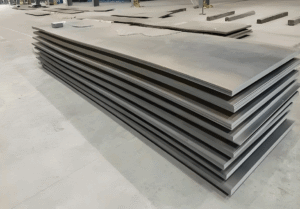
- Selection by thickness tolerance: For precision fabrication and butt welding, prefer mill plates with tight tolerances and flat surfaces. Use homogeneous heavy-gauge original plates for heavy load-bearing structures.
- Selection by budget: Prioritize cost-effective carbon steel for conventional projects. For long service life and low-maintenance requirements, invest in stainless or weathering steel to cut long-run maintenance expenses.
- Selection by quality standards: For export and high-end projects, specify plates complying with ASTM and JIS international standards. Domestic projects follow GB/T national standards; verify mill test reports for mechanical performance and chemical composition.
- Custom processing services: For non-standard sizes and special-shaped parts, adopt laser cutting and cut-to-length processing to reduce on-site cutting work and boost construction efficiency.
Frequently Asked Questions
Which steel plate works best for welding?
For general working conditions, Q355B and A36 carbon steel plates offer the best overall value, featuring good weldability, stable strength and easy sourcing. Use 304 stainless steel in corrosive environments and specialty structural steel for heavy-duty engineering.
What thickness is recommended for beginner welders?
Beginners are advised to use 3–6 mm thin plates. They are less prone to burn-through, with controllable deformation and higher fault tolerance, making them ideal for welding practice.
Can ordinary steel plates be welded?
Not recommended. Ordinary steel plates are not optimized for weldability, with unstable chemical composition and high impurity content. Welds may suffer cracking, brittle fracture or weld detachment, failing engineering safety standards. They are only acceptable for temporary, simple non-load-bearing welds.
Carbon steel vs stainless steel: which is easier to weld?
Carbon steel plates are simpler to weld, delivering better bead appearance and fewer defects for most welders. Stainless steel requires complex welding procedures and strict parameter control, reserved for skilled welders and corrosion-sensitive applications.
Conclusion
Whether for bulk industrial procurement, engineering construction, or personal DIY welding training, proper material selection combined with standardized construction maximizes the service performance of weldable steel plates.
References
- GB/T 709-2019, Hot rolled steel plates, sheets and strips — Dimensions, shape, mass and tolerances
- GB/T 3274-2017, Hot rolled carbon structural steel and low-alloy structural steel plates and strips
- ASTM A36/A36M-22, Standard Specification for Carbon Structural Steel


 English
  Spanish
  Afrikaans