
Rolled steel plate is one of the most widely‑used fundamental steel products in modern industry. Manufactured by compressing steel billets into regular plates through specialized rolling processes, it delivers stable structural performance, excellent workability and high adaptability. It is extensively applied in core sectors including building infrastructure, machinery manufacturing, automotive industry and shipbuilding engineering. This article comprehensively covers the definition, classification, technical parameters, industrial applications and purchasing considerations of rolled steel plate for your reference.

1. What Is Rolled Steel Plate?
1.1 Core Definition and Forming Principle
Rolled steel plate refers to flat steel products produced by continuously rolling, shaping, cooling and setting steel billets in rolling mills. It serves as a fundamental base material for further steel processing. The rolling process modifies the internal microstructure of steel via mechanical force, eliminating internal defects such as voids and porosity within billets. This greatly improves material density and structural stability, granting finished plates uniform mechanical properties to satisfy diverse industrial requirements for load‑bearing, fabrication and assembly.
1.2 Key Fundamental Properties
High‑quality rolled steel plates feature three core advantages that underpin their broad industrial adoption. First, they exhibit robust structural stability with homogeneous internal microstructure, delivering outstanding load‑bearing capacity and strong resistance to deformation and cracking. Second, they offer favorable workability, supporting multiple secondary fabrication procedures such as cutting, welding, bending and punching to accommodate diverse production demands. Third, they provide exceptional durability. Through material optimization and surface treatment, they can withstand complex operating conditions including extreme temperatures, outdoor exposure and heavy loads with consistent service life.
1.3 Key Differences Between Rolled Steel Plate and Ordinary Steel Sheet
In industry, the 4 mm thickness threshold is widely adopted to distinguish rolled steel plate from ordinary steel sheet. Rolled steel plate refers to regularly rolled products with thickness ≥ 4 mm, mainly deployed for heavy‑duty scenarios such as structural load‑bearing, heavy‑duty equipment and infrastructure projects. Ordinary steel sheets are defined as products thinner than 4 mm, mostly used for light‑load applications including appliance housings, lightweight fittings and decorative components. Significant gaps exist between the two in thickness tolerance, mechanical strength and load‑bearing capacity; they cannot be substituted arbitrarily.
2. Two Major Types of Rolled Steel Plate
Based on rolling temperature and manufacturing procedures, rolled steel plates fall into hot‑rolled steel plate and cold‑rolled steel plate. These two categories are core options for industrial procurement and engineering specification selection. Their performances and application scenarios complement one another to meet varying operating‑condition requirements.
2.1 Hot‑Rolled Steel Plate
Hot‑rolled steel plate is formed by rolling at high temperatures ranging from 900 ℃ to 1200 ℃. It represents the most basic and highest‑volume rolled‑steel‑plate grade. Under high‑temperature rolling conditions, steel possesses excellent plasticity with low forming resistance, enabling efficient production of large‑size and heavy‑gauge plates with good cost control.
In terms of appearance, hot‑rolled steel plate carries natural mill scale, presenting a rough, non‑glossy surface with relatively loose dimensional tolerances at approximately ±0.5 mm, making it suitable for applications without strict surface‑finish requirements. Mechanically, hot‑rolled steel plate boasts superior ductility, toughness and weldability, with a minimum yield strength of 250 MPa and tensile strength ranging from 400 MPa to 550 MPa, well‑suited for various structural load‑bearing applications.
It covers a broad thickness range, with mainstream gauges from 3 mm to 50 mm, and extra‑heavy plates can be produced upon request. It is widely specified for projects prioritizing structural strength and load‑bearing performance over surface precision.
2.2 Cold‑Rolled Steel Plate
Cold‑rolled steel plate is a high‑end rolled product manufactured by secondary precision rolling of hot‑rolled steel coils at ambient temperature; it is a downstream processed variant of hot‑rolled material. The room‑temperature rolling process eliminates high‑temperature oxidation while achieving precise control over plate dimensions and flatness.
Cold‑rolled steel plate excels in dimensional precision and surface quality. It features a smooth, scale‑free, high‑gloss finish. Thickness tolerance can be controlled within ±0.01 mm, delivering far superior flatness and straightness compared with hot‑rolled plate. Subject to work‑hardening during cold forming, cold‑rolled steel plate achieves higher hardness and tensile strength ranging from 340 MPa to 700 MPa with enhanced structural rigidity, yet its ductility and welding toughness are moderately lower than hot‑rolled alternatives.
Cold‑rolled products are predominantly thin‑gauge sheets with standard thickness between 0.2 mm and 2.0 mm. They are intended for precision‑fabrication scenarios requiring high accuracy and fine surface appearance under light‑to‑moderate loads, at higher overall production costs.
2.3 Hot‑Rolled vs Cold‑Rolled Steel Plate Comparison
| Comparison Item | Hot‑Rolled Steel Plate | Cold‑Rolled Steel Plate |
|---|---|---|
| Rolling Temperature | Hot rolling at 900‑1200℃ | Secondary cold rolling at ambient temperature (processed from hot‑rolled substrate) |
| Surface Condition | Rough surface with black mill scale, non‑glossy | Smooth and flat surface, mill‑scale‑free, fine finish |
| Dimensional Accuracy | Standard tolerance, approx. ±0.5 mm | High precision, tolerance up to ±0.01 mm |
| Main Thickness Range | 3‑50 mm (mainly medium & heavy plates) | 0.2‑2.0 mm (mainly thin sheets) |
| Mechanical Properties | Excellent toughness, ductility and weldability; moderate strength | Higher hardness & rigidity; superior precision, lower ductility |
| Production Cost | Lower, cost‑effective | Higher due to additional cold‑working processes |
| Typical Applications | Building structures, bridges, shipbuilding, heavy‑duty machinery | Automotive parts, home appliance housings, precision equipment components |
3. Main Material Grades for Rolled Steel Plate
Rolled steel plates are grouped into carbon steel plate, stainless‑steel plate and special high‑strength steel plate. Corresponding internationally‑recognized standard grades support engineering procurement and construction specifications across global regions.
3.1 Carbon Rolled Steel Plate
Carbon steel plate is the highest‑volume general‑purpose rolled steel product. It delivers cost‑efficiency and balanced comprehensive properties suitable for most conventional industrial conditions. Major international benchmark grades include ASTM A36 and S355JR. ASTM A36 is an American‑standard structural carbon steel with minimum yield strength of 250 MPa and tensile strength of 400‑550 MPa, widely used for infrastructure and mechanical projects in North America. S355JR is a European high‑strength structural steel offering roughly 40 % higher yield strength (minimum 355 MPa) than A36 and tensile strength from 470 MPa to 630 MPa, specified for heavy‑load steel‑structure projects complying with European standards.
3.2 Stainless‑Steel Rolled Plate
Stainless‑steel rolled plate provides outstanding corrosion and oxidation resistance for harsh environments including humidity, acid‑alkali exposure and outdoor corrosive atmospheres. The dominant commercial grades are 304 and 316 stainless steel. Grade 304 offers great versatility and cost‑performance for general corrosion‑resistant applications. Grade 316 delivers superior resistance to acids, alkalis and seawater corrosion, commonly deployed in shipbuilding, chemical processing and offshore‑engineering high‑end projects.
3.3 Special High‑Strength Rolled Steel Plate
These purpose‑engineered plates are developed for special service conditions. A representative grade is A588 weathering steel, featuring good atmospheric‑corrosion resistance without extra protective coatings. It forms a dense passive protective film when exposed outdoors and is widely adopted for outdoor steel structures, bridges and transmission towers.
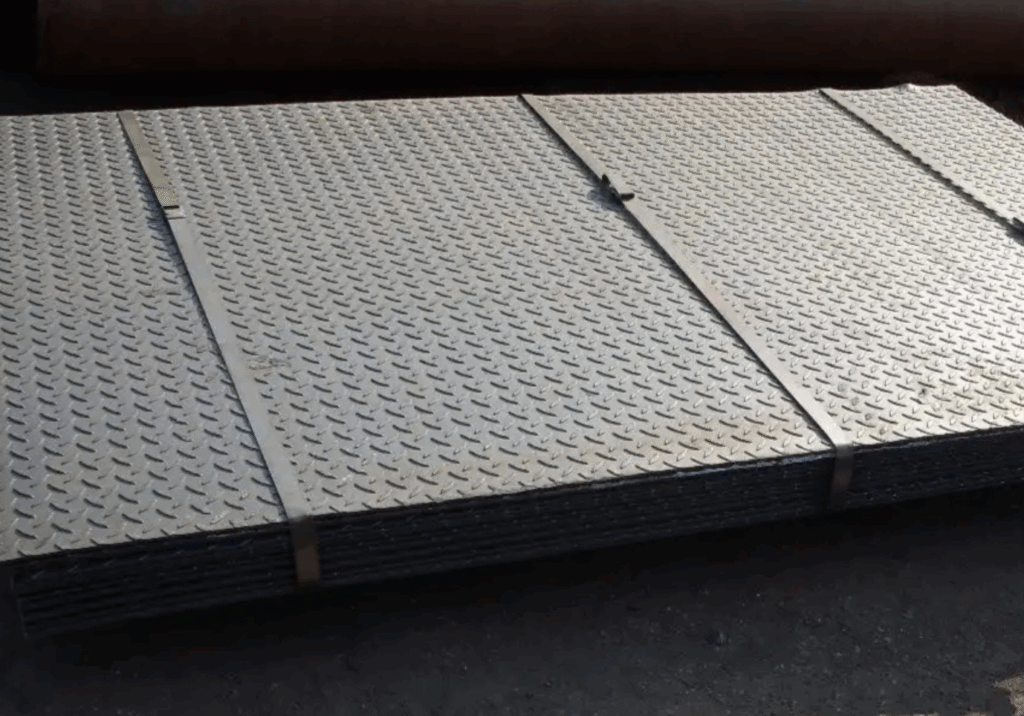
4. Specifications and Technical Parameters of Rolled Steel Plate
Rolled steel plates follow standardized dimension systems while supporting custom processing to satisfy both mass‑production and project‑specific requirements.
4.1 Conventional Standard Dimensions
Hot‑rolled steel plates normally range 1000 mm‑1500 mm in width with cut‑to‑length options, covering thicknesses of 3‑50 mm for large‑format medium‑heavy plates. Cold‑rolled steel plates match standard processing‑equipment widths with thickness concentrated at 0.2‑2.0 mm. Strict dimensional accuracy enables mass production of precision components.
4.2 Industrial Tolerance Standards
Hot‑rolled steel plates have looser dimensional tolerances for structural‑engineering applications without stringent accuracy demands. Cold‑rolled steel plates adhere to high‑precision tolerance criteria with minimal deviation in thickness, flatness and straightness. They can go directly into precision assembly and visible‑part manufacturing without secondary grinding or finishing.
4.3 Custom Processing Services
Major steel mills offer bespoke processing services including profile cutting, cut‑to‑length shearing, bending, punching, polishing and anti‑corrosion coating. Thickness, overall dimensions and surface finishes can be adjusted according to customer drawings to meet unique requirements for non‑standard equipment and special projects.
5. Core Industrial Applications of Rolled Steel Plate
5.1 Building and Infrastructure Projects
Hot‑rolled medium‑heavy plates dominate this field. Thanks to excellent load‑bearing capacity, weldability and structural stability, they are widely used in high‑rise building steel frames, bridge superstructures, workshop frameworks, subgrade load‑bearing members and municipal support frames, serving as vital raw material for infrastructure construction.
5.2 Automotive and Home‑Appliance Industry
High‑precision cold‑rolled steel plates are predominantly used here. Leveraging smooth surfaces, tight dimensional accuracy and good formability, they manufacture automotive body panels, precision chassis components, appliance housings, lighting fittings and hardware parts, balancing aesthetic quality and structural integrity.
5.3 Heavy‑Duty Machinery and Equipment Manufacturing
Hot‑rolled and cold‑rolled plates are used in combination. Hot‑rolled grades form thick‑walled load‑bearing components such as heavy‑machine bases, frames and support brackets. Cold‑rolled plates produce precision equipment enclosures, transmission parts and small fabricated components for mixed‑load machinery production.
5.4 Shipbuilding and Pipeline Engineering
Specially optimized high‑strength corrosion‑resistant rolled steel plates with enhanced impact‑resistance, seawater‑corrosion resistance and compressive performance are used for ship hulls, decks, offshore‑platform structures, industrial transport pipelines and pressure‑vessel critical components.
6. Rolled Steel Plate Buying Guide
6.1 Core Selection Criteria
Specifications should first match service‑condition demands. For heavy‑duty outdoor infrastructure, select hot‑rolled medium‑heavy plates in high‑strength grades such as ASTM A36 or S355JR to guarantee structural stability. For precision‑fabricated visible parts under light‑to‑moderate loads, cold‑rolled thin sheets are preferred to secure surface finish and dimensional accuracy. Stainless steel or weathering steel shall be chosen for humid and corrosive environments. In addition, verify critical performance parameters including weldability, bendability and hardness based on intended fabrication processes.
6.2 Key Price‑Influencing Factors
Multiple variables affect rolled‑steel‑plate pricing. Material grade is the primary driver; stainless steel and special high‑strength steel command substantially higher prices than ordinary carbon steel. Unusual thicknesses and non‑standard dimensions raise custom‑processing costs. Prices increase with more sophisticated processing and stricter precision requirements. Unit cost improves with larger order volumes; standard‑size plates are less expensive than non‑standard custom products.
6.3 Quality‑Control Points for Procurement
During purchasing, verify mill test reports and mechanical‑property certificates to confirm grades and parameters comply with international standards. Inspect plate surfaces for cracks, delamination, excessive oxidation and warping. Double‑check dimensional tolerance and flatness to avoid problems in downstream fabrication. Prioritize reputable suppliers capable of custom work and providing traceable inspection documentation to mitigate risks of defective or non‑conforming material.
7. Frequently Asked Questions
7.1 Is cold‑rolled steel plate stronger than hot‑rolled steel plate?
Generally speaking, cold‑rolled steel plate delivers higher surface hardness, structural rigidity, tensile strength and better dimensional stability. Nevertheless, hot‑rolled steel plate exhibits superior toughness, ductility and weldability. Hot‑rolled plate is preferred for heavy‑load structural applications while cold‑rolled plate suits high‑precision moderately‑loaded components. Neither is universally superior; selection depends entirely on application requirements.
7.2 Which rolled steel plate is preferred for building‑construction projects?
Hot‑rolled carbon steel plates (ASTM A36, S355JR) are the primary choice for building infrastructure, bridges and factory buildings. These grades offer high load‑bearing capacity, convenient weldability and favorable cost‑performance, satisfying long‑term outdoor heavy‑load service conditions and engineering‑safety requirements.
7.3 What is the maximum custom‑available thickness for rolled steel plate?
Standard hot‑rolled steel plate can reach 50 mm; extra‑heavy medium‑heavy plates can be produced upon special project request. Restricted by manufacturing limits, cold‑rolled products are mostly thin sheets with a conventional maximum thickness of 2.0 mm. Thicker cold‑rolled material requires special custom orders and sees limited practical deployment.
Summary
As a foundational industrial steel material, hot‑rolled and cold‑rolled steel plates serve distinct yet complementary purposes. Hot‑rolled steel plate features cost‑efficiency and high load‑bearing performance for heavy‑duty rough‑fabrication scenarios such as infrastructure, heavy machinery and shipbuilding. Cold‑rolled steel plate provides high precision and premium surface quality for fine‑manufacturing sectors including automotive, home appliances and precision equipment. For practical specification and procurement, match material grades, dimensions and processing options to application scenarios, load‑bearing requirements, precision targets and budget constraints. Strict quality assurance maximizes service performance and ensures reliability for engineering facilities and mechanical equipment.
References
- ASTM A36 Official Technical Standard for Carbon Structural Steel Plates (American Society for Testing and Materials)
- EN 10025‑2 Performance Specification for European Structural Steel S355JR
- Industry Technical Handbook: Production Processes and Mechanical Properties of Hot‑Rolled and Cold‑Rolled Steel




 English
  Spanish
  Afrikaans