
1. What is a Steel Base Plate
A steel base plate is a high-strength flat steel connecting component placed between structural steel columns, heavy equipment, brackets and other members and concrete foundations.
Its core functions are to expand the load-bearing area, distribute concentrated loads evenly, stabilize anchoring connections, and prevent local crushing of the foundation. It is an indispensable basic stress component in industrial construction, steel structure engineering and heavy equipment installation.
Core Working Principle
Concentrated axial compression, bending moment, shear force and other loads from the superstructure (steel columns, equipment) → evenly diffused through the steel base plate → transferred to the concrete foundation / subgrade.
This significantly reduces the pressure per unit area, prevents cracking and settlement of concrete caused by excessive local stress, and realizes rigid connection between members and foundations through anchor bolts to resist external forces such as wind load, earthquake and vibration.
Concept Differentiation
- Steel Base Plate: Directly supports steel columns / equipment, rigidly connected with anchor bolts, focusing on load distribution and structural anchorage. Main materials are carbon steel and stainless steel.
- Sole Plate: Placed between the base plate and the foundation for leveling, secondary grouting and auxiliary force transmission. It is thinner, has no anchor bolt connection, and is mostly made of thin steel plates or section steels.
- Embedded Steel Plate: Pre-cast in concrete for later welding connection, without load distribution function, only serving as a connecting joint.

2. Types of Steel Base Plates
| Type | Structural Features | Advantages | Typical Application Scenarios |
|---|---|---|---|
| Flat Type | Flat rectangular / square plate without stiffeners or slots | Simple processing, low cost, easy installation | Conventional steel columns, light equipment, solar PV brackets, general scaffolding |
| Drilled Type | Pre-drilled round anchor bolt holes (4 holes / 6 holes) | Accurate positioning, fast installation, compatible with standard anchor bolts | Steel structure workshops, bridges, equipment bases, sign poles |
| Slotted Type | Oblong holes / adjustable hole positions | Fine-tunable during installation, adapts to construction tolerance, flexible alignment | Solar tracking brackets, heavy equipment, components requiring position adjustment |
| Gusseted Type | Reinforced with ribs / stiffener plates | Excellent resistance to bending moment, pullout and deformation | High-rise buildings, wind towers, heavy-duty machinery, long-span structures |
| Round Base Plate | Disc-shaped with uniformly distributed radial holes | Uniform stress, torsion resistance, aesthetic appearance | Street lamp poles, communication towers, round steel columns, equipment legs |
3. Steel Base Plates Specification Parameters
- Dimensions: Conventional 150×150mm ~ 600×600mm (square), rectangular sizes customizable; thickness 6 ~ 25mm (thickness increases with load).
- Hole Layout: Standard 4 holes (arranged at four corners), hole diameter 2 ~ 3mm larger than anchor bolt diameter; slot length 50 ~ 100mm.
- Tolerances: Flatness ≤ 1.5mm/m, perpendicularity ≤ 0.5mm, hole position deviation ≤ 2mm (compliant with GB50755 and AISC 360 standards).

4. Price of Steel Base Plates
4.1 Reference Prices for Common Specifications
| Specification (mm) | Material | Unit Price (USD) | Application Scenarios |
|---|---|---|---|
| 150×150×8 | ASTM A36 | 1.8–2.1 per piece | Light equipment, scaffolding |
| 300×300×12 | ASTM A36 | 5.0–5.8 per piece | Conventional steel columns, solar PV systems |
| 400×400×16 | ASTM A572 Grade 50 | 11–13 per piece | Heavy-duty structures, high-rise buildings |
| 300×300×10 | 304 Stainless Steel | 12–14 per piece | Coastal & corrosion-resistant applications |
4.2 Factors Affecting Price
- Material: A36 ($1.2 ~ 1.5/kg) < A572 ($1.8 ~ 2.2/kg) < 304 ($3.5 ~ 4.2/kg) < 316 ($4.5 ~ 5.2/kg).
- Specification: Cost increases by 8 ~ 12% for every 2mm thickness increase; customized sizes cost 15 ~ 20% higher than standard ones.
- Purchase Volume: Unit price reduced by 10 ~ 15% for orders ≥ 5 tons; reduced by 15 ~ 20% for orders ≥ 10 tons.
5. Material Analysis of Steel Base Plates
5.1 Carbon Structural Steel (First Choice for Engineering)
- ASTM A36:Yield strength 235MPa, tensile strength 400 ~ 550MPa, excellent weldability and machinability, low cost.Application: General building steel columns, conventional equipment, indoor scenarios, accounting for more than 70% of the market usage.
- ASTM A572 Grade 50:Yield strength 345MPa, 45% higher strength than A36, excellent pull-out and bending moment resistance.Application: Heavy-duty structures, high-rise buildings, wind load / seismic zones, members with large bending moments.
5.2 Stainless Steel (For Corrosive Environments)
- 304 Stainless Steel (06Cr19Ni10): Resistant to atmospheric, fresh water and weak acid-alkali corrosion, suitable for coastal, humid and mild chemical environments.
- 316 Stainless Steel (06Cr17Ni12Mo2): Contains molybdenum, resistant to seawater, salt spray and strong corrosion, suitable for marine engineering and heavy chemical scenarios.

6. Installation and Construction of Steel Base Plates
6.1 Standard Installation Procedures (Compliant with AISC / GB Codes)
- Foundation Treatment: Concrete strength reaches over 75%, surface chiseled, cleaned and leveled, elevation deviation ≤ 3mm.
- Anchor Bolt Positioning: Fixed with positioning brackets, deviation ≤ 2mm; temporarily fastened with double nuts, threads protected.
- Base Plate Placement: Hoisted and aligned with anchor bolts, levelness adjusted to ≤ 1mm/m (using inclined shim plates / leveling nuts).
- Fastening Connection: Fastened diagonally step by step, torque meets standards (M20: 280N·m), exposed threads 2 ~ 3 pitches.
- Secondary Grouting: Non-shrink high-strength grouting material (C40+) used to fill gaps, dense without voids, curing ≥ 7 days.
- Acceptance: Inspect levelness, fastening force and grouting fullness, record and file.
6.2 Key Construction Tips (Essential for Engineers / Construction Teams)
- Leveling Tips: Use inclined shim plates for base plates ≤ 300mm; use leveling nuts for those > 300mm to avoid single-point stress.
- Anti-deviation: Install positioning frames for anchor bolts during concrete pouring, vibrator kept ≥ 10cm away from brackets, supervised by dedicated personnel.
- Anti-corrosion: Spray anti-rust paint before installation; use galvanized / stainless steel for outdoor use; touch up paint after grouting for protection.

7. Application Scenarios of Steel Base Plates
7.1 Building Steel Structures
Application: Factory steel columns, high-rise steel columns, bridge bearings, curtain wall keel bases.
Selection: Perforated A36 flat plate, 300×300×12mm ~ 400×400×16mm, 4×M20 anchor bolts.
7.2 Industrial Equipment Bases
Application: Machine tools, generators, conveyors, compressors, pump units.
Selection: Stiffened type / A36, 400×600×16mm, slotted and adjustable, vibration-resistant.
7.3 New Energy Photovoltaic / Wind Power
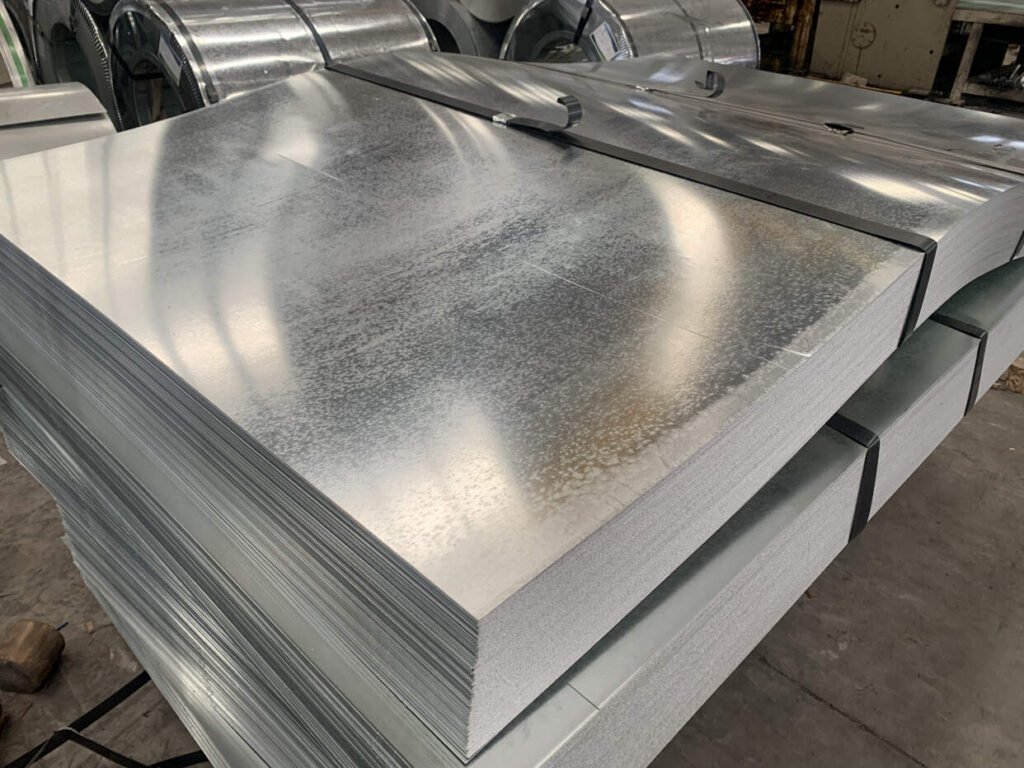
- Photovoltaic: Adjustable slotted base plate, 200×200×8mm galvanized A36, adaptable to support inclination adjustment.
- Wind Power: Stiffened 600×600×20mm A572, typhoon-resistant and large bending moment-resistant.

8. Frequently Asked Questions
Q1: How to choose the thickness of the steel base plate?
A: Calculated according to the AISC 360 formula, conventional thickness 10 ~ 16mm; heavy-duty applications ≥ 20mm; stiffened plates can be thinner.
Q2: How to choose between A36 and A572?
A: Choose A36 for general use (low cost); choose A572 for heavy loads, large bending moments and pull-out resistance (high strength).
Q3: What material is suitable for coastal environments?
A: Priority to 304 / 316 stainless steel, or hot-dip galvanized A36 (zinc coating ≥ 600g/㎡).
Q4: How to match the base plate with anchor bolts?
A: The base plate is 50 ~ 100mm larger than the column on each side; no less than 4 anchor bolts, diameter M16 ~ M30, material F1554.
Q5: Is grouting necessary after installation?
A: Absolutely necessary! Fill with non-shrink grouting material to ensure uniform force transmission, anti-loosening and anti-corrosion.
9. Conclusion
Although small in size, the steel base plate serves as the “throat” component connecting the superstructure and the foundation. Reasonable material selection, accurate thickness calculation, standardized installation and grouting are essential to ensure the safety and durability of the structure.
References
- American Institute of Steel Construction (AISC). (2022). ANSI/AISC 360-22 Specification for Structural Steel Buildings.
- AISC. (2010). Steelwise: Base Plates and Anchor Rods. American Institute of Steel Construction.




 English
  Spanish
  Afrikaans